Tuesday, September 29, 2009

Smoke on the Water

Last Wednesday a thin plume of white smoke spiraled above the tree line to the west of Yellowstone Lake. From our gillnetting boat we watched the nascent fire. Nobody much remarked upon it – the unseasonably warm, dry weather that had been lingering for weeks had provided perfect conditions for a conflagration, so the plume was hardly surprising; and we assumed the Arnica Fire would, like most little brushfires, quickly burn itself out.

A week later, nine thousand acres have been consumed, the southern half of the park is effectively closed, and Lake Village, where I live, is on the brink of evacuation. I write this post from my trailer bedroom, only a few miles north of the blaze. I, and all of my fisheries coworkers, are ad hoc (?) fire marshals; in the event of an evacuation, we’re to direct traffic and help coordinate the mass departure. Our office has been turned into the de facto fire-fighting headquarters – every morning two dozen firemen, or ‘hot shots,’ descend on our parking lot to discuss strategy. A small village of tents has sprung up on our front lawn, the dwellings of hot shots and the volunteers who have swarmed to Lake Village to help combat the Arnica Fire.

Sunset at Mary Bay. Fires may be destructive, but they're sure photogenic.


***

The National Parks Service has a complex and notorious history with fire management in Yellowstone National Park. For decades the official, misguided NPS policy, spearheaded by Smokey the Bear, was to quench every single park fire. But that policy of unilateral suppression proved catastrophic in 1988, when a gigantic inferno, fed by years of accumulated fuel load, threatened to destroy the entire park, and ultimately burned down 800,000 of acres.
Since then the park’s policy has been, for the most part, to let fires burn until they become a threat to people and property, and that's how this one has been treated. The main pocket of flames has already grown too large to douse, but helicopters have been dumping water on auxiliary fires for the last couple days, and, by spraying down our area with fire hoses, the hot shots hope to prevent the fire from spreading to the fisheries facilities.


The sun rises through a veil of smoke at Bridge Bay Marina.


Forest fires are inherently unpredictable, and nobody really knows where this one is headed next, although every shift in the wind brings with it a new round of speculation. As of now the blaze is crawling south, away from my home, but that could rapidly change. And so we remain on standby, prepared to flee, and help others do the same, at a moment’s notice. We stay alert to any sensory stimuli that might indicate a change in our circumstances: the gauzy haze drifting across the southern sky, the distant thump of helicopter rotors, the acrid smoke in our lungs.

The chaos, the volatile situation, and the disruption of our normal routine are thrilling, despite the (admittedly remote) prospect of calamity. As Erinn, another intern, pointed out: it’s like our first snow day since high school. And in fact, it's supposed to snow tonight, suppressing the fire for good. I might miss the entropy, just a little.


A helicopter dumps water on the Arnica Fire, near the marina. Not to brag, but have you ever seen cooler photos outside National Geographic?

End.

Monday, September 28, 2009

Fun With Aquatic Mammals, Part One.

As testament to my ability to have normal, touristic interactions with wildlife – i.e., ones not involving either slaughter or mortal terror – here are some pictures I recently snapped of a clan of otters (!!!). We encountered the family of six while conducting a cutthroat survey on Yellowstone Lake, and, like any slack-jawed group of tourons, followed them around (read: harassed them) for a while. I’d never before seen an otter in the wild, let alone a family of them, and so witnessing their complex, eerily humanistic social interactions was incredibly exciting. I always feel uncomfortable with ascribing animals anthropomorphic traits, and with comparing them to a human measuring stick – it’s arrogant to assume that our species is the gold standard for intelligence, considering the near-impossibility of measuring intelligence in animals. Yet otters so demonstrate all the behaviors and attributes we most admire in our own species – sociability, lingual ability, familial attachments, a frolicky joie de vivre that, say, a lake trout could never evince – that it’s impossible to watch them without thinking of them as an aquatic analogue to Homo sapiens.


Anyway, time to interrupt this ramble with some pictures:


The otters in the third picture are chowing down on suckers, a bottom-feeding fish with a vacuum-like, toothless mouth that slurps up vegetation and detritus off the lake floor. Suckers are an invasive species (though an apparently harmless one), so, good job, otters. But these otters are far from the only organisms with an affinity for suckers:

Going in for what promises to be a very wet Sucker Pucker.

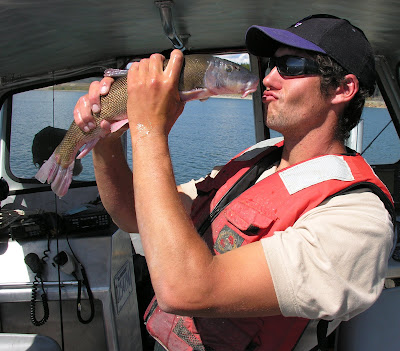
I’m not sure why I love these fish so much, but I suspect it has something to do with their indestructibility. Suckers are invincible, I’m convinced, the Rambos of the fish world. We’ve left suckers high and dry on our boat’s deck for up to an hour, then released them and watched them swim off, totally unfazed. How could you not love such a resilient fish? Any creature with a will to live so intense and a respiratory system so well evolved deserves some affection. The Fisheries Program has a tradition that every newbie kiss the first sucker they encounter; let’s just say the first sucker I met was far from the last one I smooched.

Suckers and otters were among the highlights of the cutthroat assessment, but they weren’t the only perks. We spent the week setting nets at several sites known as cutthroat strongholds, monitoring the species’ health; this brought us into contact with some gorgeous cutts – and, given the population’s failing numbers, it’s always exciting to haul up healthy and huge cutthroat.

Crew chief Brian Ertel holds up a cutthroat too heavy to register on our scale, earning the coveted "really damn heavy" on the data sheet.

Because many of the cutthroat population centers are located in the lake’s extreme southern reaches, to which the insidious lake trout haven’t yet migrated, we sometimes found ourselves setting nets several hours from our home marina. On those nights, we stayed in NPS cabins: fully furnished, albeit very cozy, houses dedicated to rangers and researchers. The first such night, on tiny Peale Island, was predictably fantastic: although a stiff wind prevented us from leaving the island via our canoe all day, the weather cleared up enough for me to take the craft out at midnight, under a canopy of stars so dense that the white swatches of Milky Way overhead nearly dispelled the blackness of the sky. The only sounds that night were bestial: the whistling howl, or “bugle,” of male elks in heat, and the eerie wail of loons echoing across the still water, the cries’ iterations reverberating from shore to shore until our island was veiled by a keening shroud of animal calls.

Sunset down the Southeast Arm of Yellowstone Lake.


***

That night on Peale Island was spectacular, but not unusual: many times Yellowstone has rendered me euphoric through its wildlife, its scenery, the solitude it provides. These last few months have been some of my life's happiest (Australia/New Zealand excepted), and that happiness, interestingly and somewhat discomfortingly, is predicated upon natural influences, and not human ones. I've gotten a bigger kick out of grizzlies and geysers than, well, people. That isn't to say I've been feeling misanthropic, but this realization demands the question: how will I do in Bangkok? Could any two places, Wyoming and Thailand, occupy more extreme ends of a spectrum? Without otters, cutthroat, and sunsets to thrill me, I'll have to squeeze my joy from societal and cultural sources; will I find such joy in the polluted, claustrophobic din of 12 million people? I can honestly say that I can't say. Stick around to find out, I guess.

End.

Sunday, August 30, 2009

The Elements of Style (when it comes to grizz stories)

One of the requisites to living in Yellowstone is a solid repertoire of near-death experiences involving aggressive, predatory, or deranged wildlife. Every park worker has had multiple such scrapes, and judging from the (alleged) frequency and danger of these encounters it’s a miracle that anybody’s still alive. Although no animal is innocuous – I’ve heard harrowing accounts of narrow escapes from mountain lions, elk, bison, mule deer, wolverines, porcupines, and even a feisty chipmunk – most of these stories revolve around the grizzly.


A bad-ass Yellowstone grizz... If only this picture were mine. (It's actually courtesy of Fox News; I feel a little nauseous patronizing their website.)

There’s an art to telling a good grizzly tale, and that art lies in making the encounter sound as perilous as possible without completely shredding the truth. (Some exaggeration, of course, is expected.) Yellowstone workers have mastered the form – I’ve heard many conversations veer into a rehashing of bear encounters, the participants trumping each other by relating increasingly farfetched and terrifying interactions, until by the end one contestant is armed only with a spork and battling a rabid grizz on a rickety rope bridge above a river of lava. (I’m pretty sure that one’s actually true.)

Every grizz story must contain a few key pieces of information to ensure verisimilitude; attempting to recount a grizz encounter without addressing all these details will expose you to suspicion of fraud. Your handy guide to grizz story-telling:

Size of Bear
  • Less than 300 pounds: meh.
  • 300-500 pounds: getting respectable.
  • More than 500 pounds: awe-inspiring.
  • More than 2,000 pounds: you encountered bear while drunk/high, adding new element of excitement to story. Give yourself a pat on the back.

Distance from Bear (always stated in yards, for some reason)

  • More than 100 yards: yawn.
  • 25-50 yards: getting interesting.
  • Less than 20 yards: pretty damn dangerous/awesome.
  • Inside tent: creepy (possibility of bestiality).
Circumstances of encounter (in ascending order of danger):

  • Bear sleeping, eating berries, scratching itself.
  • Bear standing over carcass, caught by surprise, mother with cubs.
  • Bear liquored up and throwing rocks from the Berenstein treehouse.

Don't let the smile fool you: Papa Bear is a mean drunk.


How bear was repelled

  • Shouting, waving arms: lame.
  • The art of Rhetoric: not flashy, but points for ingenuity.
  • Pepper spray: standard.
  • Gun: congratulations, asshole, our sympathies are now with the bear.


***

Whenever these bear-measuring contests arose during my first few weeks in the park, I remained conspicuously silent. My closest animal-related, near-death experience occurred last summer when a squirrel ran in front of my bike, inflicting scrapes, bruises, etc. (Traumatizing for me, maybe, but probably wouldn’t play well for an audience.) So I couldn’t really contribute much to the conversation without making an ass of myself.

I’m proud to say, though, that I recently had my first grizzly encounter. It’s pretty tame by Yellowstone standards, and not likely to win any Bear-Offs, but I won’t forget it in this lifetime.

***

I’m hiking alone down the Washburn Spur Trail, an eight-mile track leading from the top of Mt. Washburn to the Glacial Boulder parking lot, in late afternoon. It’s a cold day – snow flurries at the top of the mountain, hail on the way down – and already darkness has begun to leach into the gray sky. I haven’t seen another person in four miles.

View from the top of Mt. Washburn... my bear is down there somewhere.

The trail plunges below the tree line into thick forest. I’m walking fast, trying to beat the snow and the dark, and I’m silent; breath is a precious commodity. I approach an aspen thicket, about twenty yards ahead and to the right of the path, and the trees rattle, too forcefully to be the wind. I can’t see the animal shaking the trees from within the thicket, but some portion of my brain that operates below conscious thought, a relict from a time when humans were prey, flashes bear. There is no doubt.

I have time to take a single step backward – I’m fifty, maybe sixty feet away – before the bear plows out of the thicket. It’s a huge, tawny, hunchbacked grizz, probably 400 pounds, and it’s in no particular rush – it ambles across the path, its massive head swinging and haunches rolling with the insouciance that comes with being its ecosystem's top predator. I don’t think the bear sees me. With one hand I fumble for my pepper spray, with the other I reach for a camera. I’m not panicked, not even particularly worried: there are no cubs, no carcass, and I didn’t startle the bear. I have nothing to fear.

The bear has nearly crossed the trail when it suddenly rumbles to a halt, sniffs the air, and - ponderously, terrifyingly, inevitably - pivots in my direction. Now, well, I have something to fear. I shuffle backward, fingers fluttering to disengage the safety on my pepper spray. The myriad, and often conflicting, advice about dealing with bears passes through my mind; and yet all of it, from making myself appear as large as possible to shouting, seems risky and antagonistic, more likely to provoke the bear than drive it away. The only thing I can think to do is back away slowly and silently - even though the bear obviously sees me, and could close the twenty meters between us in literally two seconds.

The grizz hesitates and then, to get a better look at me (its rival, its quarry, a curio?) stands up on its hind legs. And, holy fucking shit, this is a big bear, eight feet tall if it's an inch. Rationally I understand that it's only reared up to satisfy its curiosity, but with a grizzly, "curiosity mode" looks an awful lot like "attack mode," and for only the, say, fourth or fifth time in my 22 years I genuinely fear for my life. In retrospect this sounds melodramatic: Yellowstone tourists suffer only one grizzly-related injury per year, and without any of the classic risk factors present, I'm not in much actual danger. In retrospect.

Another picture I didn't take. But I can definitely sympathize with the photographer.

At the time, of course, I'm pretty damn frightened. What makes the situation so alarming isn't the relatively slim danger, but my helplessness should the grizz choose to attack. Bears can run over thirty miles an hour, making flight pointless, and my little cartridge of pepper spray seems insufficient to slow the creature down. I realize that if the grizz elects to attack me, I will be, in essence, completely and totally fucked. Such utter powerlessness is rare in a technologically connected, climate-controlled, highly mobile society; perhaps the foreignness of incapability is what makes the feeling so unnerving.

After a period that feels like half an hour but is probably closer to six seconds, the grizz drops to all fours and thunders into the underbrush from whence it came. My camera, alas, is still in my pocket, but my pepper spray is unholstered and armed - a fact that makes for poor Facebook albums but bodes well for my survival instincts. I wait five minutes, allowing my anxiety to drain and be supplanted by awe at my good fortune: few humans will ever interact with such a spectacular animal at such close quarters.

I proceed cautiously down the trail, fracturing the chill air with an improvised incantation intended to ward off any lurking grizzlies:

Hey Bear!

I know you're out there

Somewhere

But I dare

Walk toward your lair

An affair

That may impair

My future ability to receive health care

And without coverage I'd despair
So please don't maul me.

Etc. (For lines 11-168, see Appendix H.)

An ominous rustle down the trail turns out to be two hikers, both in hysterics over my panicky poem. "Seen a grizz, have we?" asks one of the hikers, with a smirk. I tell my story, and they listen respectfully, oohing appreciatively at the appropriate moments.

A 400-pound grizz encountered alone on the trail, at just sixty feet, on its hind legs. I may not win any story-telling contests with this one, but at least I'm qualified to sit at the campfire.


End.

Saturday, August 29, 2009

Close Encounters, Part 1: Of Moose and Tourons

Most tourists visit Yellowstone in hopes of encountering wildlife (and not, say, slaying lake trout… though to those people I say, don’t knock it ‘til you try it). Anyway, to prove that I’m capable of interacting with nature in ways not predicated upon ritual slaughter, an anecdote from the YNP trails:

***

One of the most important, inflexible rules of hiking in grizzly country is this: do not, under any circumstances, approach an animal carcass. Grizzlies are inveterate scavengers and, even if that carcass hasn’t yet been claimed by a bear, one will soon sniff it out. And when a hungry grizz comes in search of a meal, you’re well-advised to make yourself scarce.

I’m generally a law-abiding guy, but when I stumble across a freshly expired moose not 100 yards from the trail… well, you know the adage about rules, and how they’re meant to be broken? The author of that maxim has clearly spent some time investigating the corpses of enormous mammals.


If getting excited about a giant dead moose along the trail is wrong, I don't want to be right.

I’m by myself, partway through an 11-mile trek to a mountain called Observation Peak, when I see the antlers rising from the grass to my right like topmasts. I break from the trail and wade through the brush until I find the unfortunate beast, sprawled before me in a clearing, liquid eyes half-open as though I’d caught it in a moment of repose. The carcass is fresh and flawless; it can’t have died more than a few hours ago. It doesn’t even stink yet.

I check my periphery for prowling grizzlies, and, deciding that I’m not interfering with any bear’s breakfast, gingerly prod my moose. Aside from the whole death thing, the animal looks perfectly healthy. I stroke the velvet that covers the gnarled antlers, and it’s as soft as any fabric I’ve ever touched – a texture that could never be predicted from the bleached, inanimate antlers that adorn the walls of any hunting lodge.

There’s something almost reassuring about the manner of this moose’s death, I think: there’s no bullet wound, no imprint of a car fender. It died, as far as I can tell, of natural (read: non-human) causes. And that’s why national parks exist: they’re sanctuaries for normal ecological processes, preserves not only for animal life but for death as well, places where the bodies of moose are stripped of their nutrients by bears and wolves and coyotes and returned to the soil to grow the vegetation that eventually feeds other moose, and so on and so forth. The ecosystem that I’ve been dealing with, Yellowstone Lake, is so altered and degraded by human activity that we interlopers have to actively (micro)manage it; the National Parks Service controls what fish live and die, with a guiding hand so firm upon the tiller that the ecosystem is no longer ‘natural’ in any legitimate sense. And this is true the world over: humanity’s influence has encroached upon every ostensibly wild space, whether via resource extraction or recreation or climate change. The notion that wildlife may be killed by “natural causes,” as distinguished from anthropogenic causes, is rapidly becoming obsolete. Our species is frighteningly ubiquitous.

Maybe that’s why this moose, apparently unbranded by human iron, so interests me.

Aside from being taken on that fateful Observation Peak hike, this picture is apropos of nothing; I just wanted to break up the text. I'm sufficiently secure in my masculinity to admit that half the pictures I took that day were of
cool pink wildflowers.

***

Two passing hikers, a married couple, see me examining the deceased, no doubt with such curiosity and thoroughness that I could be auditioning for CSI: Wyoming. (Wouldn't be much of a show, incidentally, since almost every crime here seems to incorporate the same two ingredients: a shotgun and a case of PBR.) The man approaches the carcass to take pictures, while the woman stays on the trail and frets very vocally about grizzlies.

I mention to her husband that her concerns are probably valid and he says, “Well, I’m a touron.”

“What’s a touron?” I ask.

“Cross between a tourist and a moron,” he says. I say that I guess I’m a touron too, and ask him to take a picture of me holding the moose by the antlers, like I’ve just bagged it. An embryonic thought about respect for the dead pops into my mind and then dies in utero: ethical concerns must sometimes be trumped by great photo ops. Flies gather on moist ungulate eyes as the shutter clicks.


This moose sacrificed its life for a worthy cause: I now have the perfect pick-up line for the next time I'm chatting up Sarah Palin down at the local hockey rink.

***

I’m returning from the top of Observation Peak that afternoon when I meet three backcountry rangers. They’re closing the trail, they tell me: grizzly activity near the carcass has made the route unsafe. A 500-pound bear named Scarface has been spotted near the moose, and though Scarface is typically benign, I can certainly understand why the authorities would want to minimize contact between a feeding grizz and a park full of tourons. The rangers and I piece together a timeline, and decide that Scarface must have entered the vicinity less than twenty minutes after I vacated it. I part ways with the rangers (after a long conversation about fly-fishing, of course) and head for the trailhead, feeling in equal parts fortunate and disappointed that Scarface and I hadn’t crossed paths.

I have no idea that my first brush with a grizzly will occur much sooner, and at much closer range, than I could possibly expect. (Cliffhanger!!!)

End

Tuesday, August 25, 2009

Consider the Lake Trout. Or, on Second Thought, Screw 'Em.

David Foster Wallace may have felt reservations about whether it was all right for humans to boil crustaceans alive for our gustatory pleasure… but would he have felt similarly reluctant to bash the head of an invasive fish against a boat railing? Would the famously compassionate writer have been able to stomach the extermination of an entire population of trout?

Would he have objected to the ruthlessness of the project, or would it have been the mode of extirpation that bothered him: the gillnets draped beneath the surface of Yellowstone Lake like invisible, lethal cobwebs, ensnaring and suffocating all piscine comers? Could any method of slaughter mollify the sensitive, thoughtful DFW?

Perhaps not. Good thing I'm a jerk.

***

Maybe we all possess some latent, Wallacean compassion within our souls… but lake trout - the invasive species that is threatening Yellowstone National Park's ecosystem, and that I have been contracted to eliminate - definitely don’t activate that warmth within me.


An evil, invasive lake trout disgorges a juvenile native cutthroat trout. I see this image in my nightmares.

Lake trout look, first, like the enemy: torpedo-shaped body and elongated, toothy jaws; sinister black mottling that must make them impossible for their hapless prey to detect; and even – though I must be imagining this – a certain willful malignancy in their soulless eyes. (Anthropomorphizing nature is typically a marker of authorial weakness, one which Ed Abbey in particular hates, but I swear that in this case it's applicable and valid. Really.)

The cutthroat trout, the good guys, on the other hand, look as virtuous as the lakers do evil. The cutts are beautiful fish, ranging in coloration from pale gold to pink to deep red, constellations of black spots along their flanks, and their faces possess the same hollow, dopey, good-natured, preyed-upon vacuousness as sheep. The point is, it’s easy to choose sides.

A cutthroat trout... ain't he adorable? Dontcha just want to kiss him? Me too.

Malevolent countenances aside, the lake trout are horrifically destructive. Introduced by fishermen (short-sighted bastards) in the mid-‘90’s, their population has metastasized explosively, so much so that the National Parks Service has managed to remove 70,000 (!!!) this year without even making a dent in their numbers. Yellowstone Lake contains, in fact, one of the healthiest lake trout population in the country. If you’re ecologically inclined, they appear to be both a k- and r-selected species, meaning that they reproduce rapidly and live forever (up to fifty years, compared with eight or nine for the oldest cutthroat.)

Lake trout are voracious and efficient predators; our autopsies of them reveal bellies full of young cutthroat. Juvenile cutts, not incidentally, are very rare in Yellowstone Lake – while our nets pull up hundreds of fledgling lakers measuring 300 mm or less, the only cutthroat we see are the real ‘hogs,’ adult fish over 500 mm. This discrepancy troubled me for a while, until the blindingly obvious solution arrived: there are no young cutthroat, of course, because they get devoured; this creates an unsustainable population skewed toward the large and elderly. The situation’s like an aquatic Children of Men.

If the lake trout only ate the cutthroat, the ecosystem’s prospects would be grave, but not dire. Unfortunately, the lake trout exhibit another deleterious behavior: true to their name, they don’t leave the lake. While the cutthroat trout migrate up Yellowstone Lake’s many branching streams to spawn, the lakers do their baby-making in the deep waters of the lake itself. Problem is, many other species, from grizzlies to eagles, depend on the migrating cutthroat for food: once the fish leave the safety of the lake’s depths and enter shallow stream waters, they become accessible to these predators. If the lake trout supplant the cutthroat, this migratory buffet will vanish, exposing terrestrial species to starvation. To synopsize, and hopefully impart the gravity of the situation: if the lake trout aren’t removed, the entire ecosystem of the most iconic National Park in America is in jeopardy. And right now, the lake trout are winning.

***

Fellow intern Erinn Hasselgren holds up a record-setting 25.75 lb lake trout, the largest ever removed from Yellowstone Lake. Obviously this would never have been possible were it not for Erinn's sweet hat. Picture courtesy of gillnetting legend Adam Lohmeyer.

So, yeah, lake trout suck. And that’s why, whenever our nets drag a live, writhing laker to the surface, I have no trouble slamming the fish against the gunwale until it stops twitching. I’m not out to induce suffering, but I very much want the fish dead.

But truly I’m a scientist, not a slaughterer*. I’m part of a three-man reconnaissance crew currently conducting a Lake Trout Distribution Assessment, trying to figure out where the lake trout have established their strongholds**. Once we’ve identified a pocket of lakers, we send in the true grim reapers, the larger and better equipped factory ships capable of doing the really hardcore killing: a typical day for the Freedom, our fleet’s flagship, is eight hundred lake trout.


Fisheries technician Jason "Babyhands" Bunn strikes a familiar pose. Note the artfully placed "crotch trout." Picture courtesy of Alex Crouse.


***

I realize that slaughtering fish, and then handling their slimy, bloody, reeking corpses, is not everybody’s cup of tea; in fact, you may right now be wondering who in their right mind could enjoy a job that leaves one stinking like the dumpster behind your local Red Lobster***. But despite its gruesome, odiferous nature, I love this job. Or maybe I love this job not despite its gruesome, odiferous nature, but because of it: because it’s so far removed from Amherst’s sterility; because it activates and caters to some gloriously foul childhood instincts; because, after performing this job, I feel confident that nothing could ever disgust me again. I can now perform any nasty task without the slightest aversion; such imperviousness to all things gross is not only useful, but also, blessedly, pushes me further from a world of white collars and unstained shirts that I may never be ready to enter.

Familiar circumstances for me: holding a fish, and grinning like Ralphie Parker on Christmas morning.

***

Or maybe it’s being on the lake that I love: the enormous gray lake ringed by jagged mountains whose foothills plunge to touch the water’s edge, closing us off from the obnoxious, crowded world beyond. Setting nets and hauling in fish is fun, for sure, but my favorite part of each day is the time we spend with the throttle open: the skiff bouncing across the swell like a skipped stone, the roar of the engine reduced to gentle white noise by my earmuffs, an expectant parade of seagulls trailing us like acolytes. We’re on the edge of a storm front; the blunt heads of thunderclouds race us toward shore. Behind us a skein of rain turns the mountains gray, then blots them out; before us the sky is still blue and brilliant – it’s as though the storm is tethered to our stern, as though we’re dragging it behind us like a cape. Behind us, Yellowstone’s vast, forbidding backcountry turns black in the gathering dusk.


The unimaginatively named (but still beloved by me) Work Skiff 1 at rest on Peale Island, about a billion miles off the beaten path.

I look forward again – toward the clear sky, the gentle chop, the slab of fresh lake trout I can already smell sizzling in a pan (the wastivore's paradise!), and the warm sleeping bag. The wilderness can wait.

End.


*In addition to killing the fish, we also take reams of data – including our victims’ lengths, weights, sexes, degree of sexual maturity, and, most interestingly, age. The latter is calculated by removing from each fish its otolith, a pinhead-sized piece of bone, located approximately between the eyes, that can be used like the rings of a tree core.

**As the Distribution Assessment team, we often set our nets without knowing whether we’re above lake trout habitat; consequently we haul in a large number of cutthroat as bycatch, much to our chagrin. The lake trout favor deeper waters (>30 meters), while the cutts prefer shallow (<20 m); thus a net set in shallow water is almost assured to catch predominantly cutthroat. Still, the Powers That Be, in the name of complete scientific rigor, have instructed us to set nets in the shallows as well – despite our crew's protestations. Therefore we continue to catch cutthroats, the species we’re ostensibly protecting, in tragic numbers. Well, to make an omelet…

***If, when next I see/hug you, I still smell like a wad of sludge dredged up from the floor of the Long Island Sound, rest assured that, all odors to the contrary, I have showered in the last four months.

Monday, August 3, 2009

To Kill a Hornworm (on a No-Harm Farm)

Note: I've now left the farm and moved on to Wyoming, but I began this post a couple weeks ago and only managed to finish it now (at a breakfast buffet in Jackson Hole, surrounded by a gaggle of senior citizens just disgorged from a tour bus). Sorry for the temporal confusion.

***

My favorite farm task, now more ritual than chore, is the hunt for tomato hornworms. The tomato hornworm, for the uninitiated, is an immense green caterpillar – as thick as a thumb and as long as an index finger, with trademark spike rising from posterior – capable of wreaking immense destruction on a tomato plant: a single caterpillar, emerging from its underground burrow during the cool of the morning to feast, can kill a plant in two days.

The spine on the hornworm's ass not only deters predators,
but also picks up satellite radio.

Unless, of course, we capture the hornworm first. They’re well camouflaged, but with experience one can learn to identify the tattered leaves that betray their presence; one veteran farmhand even scans the ground for tiny clusters of hornworm scat. By now the hornworm hunt has abated, a victim of its own success, but during the infestation’s heyday about two weeks ago, 20-worm days were not uncommon. I’m in the minority in this regard, but for me there’s no farm feeling more satisfying than prying a plump worm from a beleaguered stalk and depositing the pest into a bucket to writhe with its fellow captives and await its fate at the bottom of this holding cell.

***

And what fate is that? Well, annihilation, obviously – except at Hell’s Backbone Grill, that answer isn’t so obvious. See, HBG calls itself a “no-harm farm,” which ostensibly means that no animal, no matter how vicious, malicious, or pernicious, can be killed for any reason on the farm’s premises, or the restaurant’s. Not a mosquito may be swatted, not a housefly liquidated, not a grasshopper crunched underfoot. The restaurant owns an honest-to-goodness bug vacuum, a suction device resembling a baster that gulps up insects and spits them outside; the suction-ee emerges unharmed though perhaps disoriented, as if after a spin on a miniature Tilt-a-Whirl.

The no-harm policy was instated by Blake Spalding, the restaurant’s owner. Blake is a Tibetan Buddhist, and her belief system dictates that every organism is possessed of a soul, and thus of the right to life. Insofar as I understand Buddhism (which admittedly isn’t very far), the notion of “self” does not exist, and all beings are components of an interconnected universe; although there’s definitely a hierarchy of organisms, our place in the hierarchy is fungible, and our karma can be reincarnated into any animal, more or less based upon our virtuousness. Follow all that? Because I didn’t. Anyway, the upshot is that humans, despite our karmic superiority (go ahead, pat yourself on the back for not being reincarnated as a nematode), are still but cogs in this universe of connectivity, and we wouldn’t exactly be team players if we ran around spraying RAID on our teammates.

Note: if anyone has a better explanation of why Buddhism precludes killing – and someone must – please post it in the comments. Please?

I don’t find the no harm policy all that remarkable – aside from its basis in religion, it doesn’t much differ from how I live my life. Biting insects and invasive species excepted (I’m looking at you, cane toads and lake trout), I live and let live; I could never, say, flush a spider down the toilet. So I’m not so much interested in the policy itself. Rather, I’m fascinated by the way it collides with the business of running a farm and a restaurant – when and where “no harm” is inconsistent, impossible, or even hypocritical.


When I first arrived in Australia, I was reticent to inflict any injury upon cane toads, despite their vileness. By the time I left, my reputation as ruthless toad slaughterer had spread across the continent. (I like to picture Daniel Day-Lewis playing this version of me in the cinematic adaptation of my life.)

***

Before I came to HBG, I considered farms epicenters of death as much as they were breeding grounds for life. To my suburban mind, farms were the places where young, overall-clad children learned the cold facts of existence, learned that their beloved lambs were eventually destined to confront the Great Meat Hook in the Sky – and that death was a sad but necessary prelude to the birth of new organisms. Having never been to a farm, my impressions also relied upon fiction writers; and the best agriculturally-themed novelist I know, Jane Smiley, sometimes seemed obsessed with death. A single novella, Good Will, depicts the (somewhat graphic) demises of a turkey, sheep and pony in quick succession. Based on that piece and others, I viewed farms as places where death occurred frequently, inevitably, naturally, and moralistically – indeed, maybe the only place in American society where death wasn’t creepy, stigmatized, and postponed desperately. (Healthcare rationing plug!)

So you’ll understand why the idea of a no-harm (read: anti-death) farm seemed inimical to all my notions of, well, farmness. At first I was taken back: the concept seemed impossible. I’ve come to see, though, that HBG doesn’t shy from harm, but rather codifies it, confines it to certain circumstances and methods. Imagine deciding to keep kosher – except, well, you just have to have shrimp cocktails, and what’s one pig-in-a-blanket anyway… and, hell, pass me that ham and cheese sandwich.

***

Hell’s Backbone Grill is, believe it or not, a grill, and it would hardly qualify as one if it didn’t serve meat. HBG offers chicken, pork, beef, and reindeer; for an establishment that takes such pride in its vegetables, vegetarian menu options are slim. This fact creates an absurd situation: while employees are made to painstakingly release every insect that alights within the restaurant, innumerable warm-blooded organisms – with presumably better karma, no less – are dying on the restaurant’s behalf. Fretting over the insects, to me, is a bit like going crazy over piddling executive bonuses after AIG absconds with $170 billion. (There’s probably a more precise analogy that I’m missing. Whatever.)

So is this hypocrisy? Maybe, but it’s solid business sense. A vegetarian restaurant in southern Utah would last about as long as a snowflake – this is a meat-and-potatoes region, and go easy on the potatoes. Without steak (and meatloaf, and filleted trout, and beef posole) on the menu, the restaurant wouldn’t stand a chance, so I certainly understand why the owners sublimated their religious beliefs. (Good thing they did, too: the meatloaf is phenomenal, and big enough so that leftovers often fall into the patient mouth of the wastivore, hovering around the dirty dish section of the kitchen like a hyena skulking behind a pride of lions. I have no shame.) And, to their credit, the restaurant tries to make each animal’s journey into the Great Beyond as pleasant as possible: every creature ticketed for slaughter is fed a special tincture in their last slop bucket or grain bin, which somehow expedites their being’s passage into the next life. I’m guessing the pigs, if asked, would probably prefer a heartier final meal, but if the tincture puts the ownership’s mind at ease, well, at least somebody’s happy.

Don't worry, Buddhists: no trout was harmed in the preparation of HBG's
pecan-encrusted trout. Ummm...


***

And what of those malignant hornworms? Are they laid gently on a leaf, with nary a horn harmed? Hell no: we feed ‘em to the chickens, which use every delectable worm as a tug-of-war rope. These melees (often spectacular to watch, as long as you stay clear of the flying feathers and mutilated caterpillar body segments) are anything but harmless; in fact I can’t imagine a more brutal way for a ripe hornworm to perish. Anybody who considers chickens herbivorous, by the way, couldn’t be more wrong. Not only are they voraciously omnivorous, but to see them pursue grasshoppers among the cornstalks, heads bobbing and beaks thrusting and throats clucking murderously, is to be reminded uncomfortably of a pack of velociraptors. The final moments of the caterpillar’s life, in which he’s shoved unceremoniously through the chickenwire into a thicket of clamoring open maws, must be as terrifying as they are undignified. Even pests deserve better. (No, they don’t.)

Is this, then, hypocrisy? The chicken may be the agent of death, the avian guillotine if you will, but we humans – we, who as HBG employees have sworn to inflict no injury to any living thing – are judge and jury (and really enthusiastic spectators, too). Is it fair to put the onus of ill karma on the chicken? Are we dooming each chicken’s soul to many lifetimes of misery – in the body, say, of a tapeworm, or a Pirates fan – by forcing them to execute the hornworms we’ve sentenced?

(For that matter, are we doing the hornworms a favor by killing them, and thus freeing their souls to recommence in a body higher up the food chain, and one perhaps more sentient? Aren’t we hastening their matriculation into life as a komodo dragon, or a sea otter, or an orangutan? I feel like truly compassionate Buddhists would call themselves the Invertebrate Liberation Army, and go around stomping on every six-legged creature they encounter. When it eventually ascends to Lama-dom, the gnat I just crushed will thank me.)


Despite the weirdly anthropomorphic quality of these carrots, they were not spared the wrath of the HBG chefs. (Okay, fine, this picture has nothing to do with the content of this post; I just think it's really cool.)

***

Well, I’m a pagan, not a Buddhist, and a human, not a hornworm, so it’s all academic to me. I don’t actually think the farm’s owners are guilty of hypocrisy; I think they’re pragmatists, and doing the best they can to navigate some turbulent ethical waters. And I was sufficiently interested in Blake’s perspective to ask her what she thought of my new job, the one I’m starting today (Monday, August 3rd): professional killer.

For those who don’t know, I’ll be working for the Aquatic Sciences Program in Yellowstone National Park, and my job, in a nutshell, is to slaughter as many fish as humanly possible. (To get a sense of how many that is, know that the National Parks Service has killed 275,000 in the last year.) I’m not just killing any old thing with fins, though: I’m whacking lake trout, an invasive species that is edging out native cutthroat trout throughout Yellowstone, thereby wreaking havoc on the park’s ecosystem. Eradicating them, scientists agree, is not only permissible but essential. So the killing’s justified – but would a Buddhist think so?


This beautiful rainbow trout, which I hooked at Garkane Lake, was allowed to live. Were it a lake trout, though, I would not have been so merciful.

One night I accost Blake while she’s crunching the restaurant’s finances, explain to her the murderous parameters of my job, and ask her that very question. She winces when I described the epic scale of the extermination, but doesn’t comment; clearly she’s tactfully reluctant my line of work, but just as clearly she finds it a little repulsive. I still don’t know if I can stomach it, by the way; I guess I’ll find out shortly.

After I’m finished, she concedes, “Well, it’s definitely killing for the greater good.”

That’s right, I say, nodding enthusiastically.

“But it’s not like the trout themselves did anything wrong,” she adds, providing the caveat to her own line of reasoning. “They’re just doing what they do. It’s our fault they’re there.”

Well, that’s true too, I concede. I assure Blake that I bear no animosity toward the lake trout themselves. Like Michael Corleone, my motives are strictly professional, and the trout happen to be Fredo.

Blake taps her pen against the table and looks out the window, at the moths hurling themselves fecklessly against the porch light. No bug zapper on this deck. She turns back to me with pursed lips.

“If I were you,” she says, “I would just try to remember our connectedness to every fish, and wish each one well.” She shrugs – it’s not much advice, but it’s something. And when you’re the Grim Reaper of the piscine world, you appreciate any tidbit that might help you preserve your humanity. So, in sum, for all my lake trout readers out there: best wishes.

(And sleep with one eye open, motherfuckers. I'm coming for you.)

End

Saturday, July 18, 2009

The Hitch-Hiker's Guide to Capitol Reef

I have a day off from farm work, and I drive to Capitol Reef.

Capitol Reef is Utah’s unfairly forgotten National Park, not as famous as Arches or Zion but just as spectacular. Jagged spines of rock (the titular reefs) abut and collide; monoliths and spires tower over lofty mesas; the rocks glow a Martian red. There’s a darkness, though, a sinister quality to Capitol Reef’s grandeur – like the place is trying to lure tourists into its lovely recesses, only to leave them dead of thirst in a remote canyon.

I get there at the worst imaginable time: noon. A thermometer at the ranger station tells me the temperature’s 102 degrees. That sounds conservative. When I get out I can almost feel the desert drawing my bodily fluids from me, greedily drinking my evaporating insides. A small refugee camp of motorcyclists sprawls in the shade beneath the ranger station’s awning, gulping sodas desperately.

Right now all the scenic hikes are out of the question – no way am I tackling anything involving an elevation gain. I consult my map. Only one hike seems tenable: Sulfur Creek, a sinuous canyon with a stream coursing along its bottom. The map forecasts constant fresh water (potable, despite the creek’s ominous name), shade from the canyon walls, and a downhill pitch. What could be more perfect? I park my car at the Chimney Rock trailhead, where the stream originates, and plunge into the canyon.

It’s a great hike, everything I dreamed of and more. Unfortunately my camera has developed some focus issues and is in the untrustworthy hands of a Panasonic repairman, so there’s no photo documentation, but rest assured the canyon is beautiful, a maze of orange sandstone walls and wild rock formations. I take my shoes off and walk in the streambed. It’s at least twenty degrees cooler down here, and I hardly break a sweat. In a couple of places the canyon walls narrow into a kind of chute, and the only way to proceed is to slide down a short waterfall into a pool below. At one of these falls I encounter the only human I meet on the hike: a stout German man walking upstream. He’s hurling himself against the face of the waterfall like a crippled salmon, in desperate search of a foothold with which to climb the falls. I ask him how long he’s been trying to climb and he tells me twenty minutes with a sad shake of his head. I ask him how much longer he plans on keeping it up and he shrugs – discouraged but unbroken.

***

The stream eventually peters out in a culvert beneath the highway, about six miles from the trailhead. Now what? I don’t feel like walking upstream to my car, and those falls seem impassable anyway. I pause to assess my options, then clamber out of the streambed, cross the highway, and stick out my thumb.

***

A steady trickle of cars rolls past me, about a vehicle a minute. None of them stop. The asphalt is sticky with heat – if it was 102 at the ranger station, it’s 110 here. Not a chance I’m walking six miles over this desiccated, deadly road. Unremitting slickrock flats peel away from the highway and stretch into the distance – there’s not enough shade to shelter a lizard. Sweat dries as soon as it appears on my arms, leaving behind a white skein of salt. Minutes tick by – ten, fifteen, twenty.

I grow accustomed to the different forms of rejection. Most common are the SUV-encased Midwestern families whose burly, mustached fathers give me apologetic waves as they pass: I’d like to pick you up, but, you know, we’ve got five tons of luggage and two sleeping kids in the backseat, and besides, my wife, well, she’d never have it. There are worse ways to get shot down. Some cars accelerate when they see me, cross the meridian to give me a wide berth, their drivers doggedly avoiding acknowledgment of me behind their mirrored sunglasses. Others slow down as if mulling it over, cruelly raising my hopes before dashing them by cruising past. I’m not the ideal hitcher, I know: I’m too big, too unkempt, too male. Hell, I wouldn’t pick me up.

Rarely in my life have I wished I were a petite girl. Now is one of those occasions. I throw down my pack and sit on it. I’m destined to be here a while.

***

I stick out a disconsolate thumb, more out of habit than hope, at the next car that comes growling up the hill. And, holy shit, miracle of miracles, the right turn signal flashes and the car pulls to the shoulder. I’m saved.

I spring to my feet and reach for the passenger’s door but the driver, his face obscured by tinted glass, waves me to the back. Fair enough. I toss my pack onto the backseat and slide in after it, babbling my thanks.

Where are you going? asks the driver in a clipped Japanese accent over the roar of the air conditioner. The car is freezing, maybe sixty degrees. The man doesn’t turn around, but I can see dark hair gone gray at the temples above a stiff white collar.

Only going a couple miles, I assure him, and explain my situation. Just a few miles, the man repeats, and he sounds relieved that he won’t be saddled with me for too long, though maybe a little regretful too – as though picking up a hitcher frightens and intrigues him at the same time.
Too hot to walk, he adds, turning around to give me a sympathetic half-smile. I take stock of my Japanese benefactor. He’s wearing a freshly starched shirt tucked into slacks flawlessly pressed, and not a hair is askew on his neatly waved head. He looks like he’s just emerged from a business lunch.; there’s no way he’s stepped outside of his car today. He looks sixty years old, but thin as a fence post, and, from the ungainly way his legs are folded beneath the steering wheel, very tall. His watch glitters.

This man and his ensemble couldn’t be more out of place here, in this land of beefy, rumpled Americans sporting sweat beads on their bald spots and chocolate stains on their cargo shorts. My driver is the Ted Williams of tourism, cryogenically preserved by his humming air conditioner, perpetually immune to the desert’s powers of dishevelment.

Way too hot, I agree, and launch into a spirited discussion of the weather – how it’s hotter down here than it is up in Boulder, and how it’s hotter today than it was yesterday, and how it’s hotter on the road than in the canyon. If I’ve gained no other skill from my month of farming, I’ve mastered the art of banal weather-related chatter. For the farmer the weather is life and livelihood, and every staffer at Hell’s Backbone – me included, now – monitors its fluctuations obsessively. We spend our mornings analyzing the meteorological implications of every flock of clouds scudding across the eastern sky, and our afternoons in meta-analysis: how we thought those clouds portended rain, but, wouldn’t you know, they just missed us to the south, and, well, you never can tell with weather, can you?

When my monologue – punctuated by my driver’s bewildered nods – has run its course, I ask him where he’s from, where he’s going, how long he’s in the States. All the relevant particulars. He grips the steering wheel with two hands and answers tersely. He’s from Tokyo, here on vacation. He doesn’t know where he’s going, maybe Salt Lake. And how long is he in the States? He tilts his head. Until I leave, he says.

I get the impression that he doesn’t feel comfortable speaking about himself, and as soon as he’s answered my questions he asks me where I’m from.

New York! he exclaims, turning suddenly voluble, after I tell him. New York man! You must be very rich man, from New York. He’s mocking me a little, but good-naturedly.

If I was rich I wouldn’t need to hitch rides, I say.

Maybe you lose all your money on Wall Street. Economy very bad here. Very bad.

That’s why I’m in Utah, I say. And not New York.

You travel alone? he asks me. You have no wife?

Me? Ha. No.

That’s good, he says. He nods solemnly, at the sagacity of bachelorhood. You are free agent.

I laugh. That’s right, I say. A free agent.

Lock up daughters, he says, chuckling at himself, and he glances at me in the rearview mirror to see if I appreciate the colloquialism. I do, and laugh and nod. He grins back.

And what is your career? he asks me.

My career? I barely have a job, I say. No career.

He looks at me in the mirror again. What you doing out here? he asks. He adjusts his glasses on his nose, and says, with incredible perspicacity, You are walking around all day and thinking about your future.

I laugh and look out the window, the aloof slickrock flats whizzing past, almost too bright to stare at without sunglasses. Walking around all day and thinking about my future. Man, I say, that’s exactly what I’m doing.

***

We crest a hill and the valley unfurls below us, scarred with canyons that twist and writhe their way toward an orange horizon. An immense fang of blood-red sandstone juts from the earth a mile down the road: Chimney Rock, where my car is parked. In a minute I’ll be back in my own iron capsule, and my mysterious patron will vanish into the desert in his.

What about you? I say. You have a job? Family?

We plunge into the valley, the car gathering momentum and speed, and the driver doesn’t say anything. I’m not sure if he’s heard me over the AC, and I’m about to repeat the question, when he draws a weary breath. I wait for him to speak; I realize I'm holding my breath.

I am finished, he says at last, and the exhaustion and melancholy in that finished is tragic – a quiet, dignified, Willy Loman brand of tragedy. An ultimate finish. A finished that implies that everything, everything, is behind him.

Two kids, he says. We’re getting close to the Chimney Rock turn-off; he shows no signs of slowing down. All grown up, he says. I retired job two months ago.

I almost say congratulations but the word dies in my throat.

Wife, he says… and then he doesn’t say anything. I wonder if they’re divorced, or something worse. I do not ask.

And that, maybe, is what he's doing here, incongruously dressed in the American West - all those things that have provided his life meaning for the last sixty years are defunct, expired, depleted. He needs, I think, a new reason to live. And this trip is a (perhaps desperate) attempt to find one. My driver stares blankly out the windshield and the car thunders downhill.

The turnoff is fast approaching, but he shows no signs of seeing it – he’s in some sort of trance, some blind reverie. At the last second, when we’re almost past it, I blurt out, Here it is, and he comes to and jerks the wheel and swerves into the parking lot, trailing a plume of dust. I see my car, and it’s strangely comforting to find it so unchanged: tattered road maps on the rear window ledge, stalactites of dried mud hanging from the wheel wells.

I thank him for the ride and jump out, my keys already in my hand, pack again on my shoulder. Then I glance back, I don’t know why, and he rolls down the passenger’s window.

Can you hike up there? he asks. He’s pointing at the ridge, sheer and exposed, that runs up the fins adjacent to Chimney Rock. A narrow ribbon of trail switchbacks up those rocky spires and vanishes around their side. Beyond the fins lies wilderness, stark and murderous. Hot, barren, unforgivingly dry wilderness.

Looks like it, I say. If you wanted to.

The driver stares past me at the perilous, strenuous trail. Maybe I do, he says, and rests his fingers on the door handle, about to disembark. I imagine him climbing those spires, his collared shirt and pressed slacks gathering red powder and turning shapeless. I picture him alone at the summit as dusk gathers, his gangly frame silhouetted against a fat yellow moon like Ichabod Crane, blundering cavalierly into the night with a whole troop of Headless Horsemen – his obsolescence, his loneliness, his ghosts – in close pursuit. If he goes up that trail, I think – and I’m not being melodramatic – he doesn’t come back.

He hesitates a moment longer, and then takes his hand off the handle, stays in the car. Take care, he tells me, and swings out of the parking lot back onto the highway, disappears over the next rise. The miasma of grit kicked up by his tires hangs in the lot.

***

Whatever he’s looking for, I hope he finds. Maybe, too, he’s wishing similar luck for the not-so-rich New York man walking around, thinking about his future. I have more confidence in my own soul-searching than I do in his, though.

End.