Tuesday, January 12, 2010

Supposedly Delicious Things I'll Never Eat Again

Part of my motivation in coming to Thailand was to have a sort of epicurean picaresque, and this country has, as advertised, introduced my palette to wonders. I could, I suppose, enumerate all those incredible and commonplace dishes that make each day a small gastronomical adventure - the gang kiaow, the tom yam goon, the pad si-iew (sics all around, I'm sure), the innumerable delicacies I've ordered by walking into nameless hole-in-the-wall noodle shops, pointing at an adjacent table, and saying, "I'll have what that guy's having." The promise of delicious food is one of the temptations that coaxes me out of bed every morning.

Still, there are exceptions, moments of queasiness embedded like knots of gristle within the general scrumptiousness. And, since culinary oddities are bound to be more fun to read (and write) about than ordinary comestibles, I present the aforementioned supposedly delicious things.

***

Thai cuisine isn’t as industrious as Chinese when it comes to making use of every dubious anatomical scrap. I’ve had fish bladder soup and fried pig intestine (both terrific, incidentally), but I’ve actually been a little disappointed by the lack of esoterica on Thai menus.

Last week in Phuket, though, I partially sated my hunger for random body parts with a bowl of chicken feet stew. The stew’s presentation was impressive, in that gleaming and terrible way that weapons can impress: my bowl brimmed with fierce, denticled talons that looked still capable of scratching out the eyes of an incautious farmer. I fully expected a claw to spring to life, clutch me by the wrist, and plea that I spare it the acidic rigors of my digestive tract.


You can barely control your salivary glands right now, I'll bet.

Once I resolved to show the feet no mercy, I was confronted with the conundrum of how to consume them. Chicken feet are essentially skeins of rubber stretched over a lattice of fine, inedible bones – tarsals and metacarpals and phalanxes expressly designed to choke diners. I set about meticulously removing shreds of plasticine skin from the tiny bones, no doubt expending more calories in surgery than I stood to gain in consumption*. It was a task for scalpel and forceps – even knife and fork would have been inadequate – yet I undertook the operation with only plastic ladle and wooden chopsticks, a woefully indelicate arsenal; I might as well have tried to defuse a bomb with hammer and chisel. Five laborious minutes later, I’d picked pebbled skin fragments from about two toes; the cairn of bones perched on my plate seemed an unjustly miniscule monument to my tenacity.

“Come on, guy,” my dining companion, Take (my co-teacher at DSIL) sneered. (“Come on, guy” is Take’s standard expression of reproach whenever I’m particularly obtuse, which, in Thailand, is often.) “Whatchoo doing?” I looked up from my toils and across the table at her: a chicken foot dangled from her mouth, a tableau that conjured images of foxes and henhouses, and two more claws lay on her plate, as clean and intact as skeletons in an anatomy class.

“Like this,” explained my vulpine friend, and she sucked at the talon – apparently ladle and chopsticks didn’t figure in this procedure after all – and tossed the skinned foot aside with a velociraptorish grin.

“Oh,” I said, duly shamed.

Chicken feet, it turns out, aren’t especially delectable even once you’ve solved consumptive difficulties (or had the mystery cracked for you). They’re rubbery, of course, and have an almost neutral flavor; the myriad bones, I learned from accidental experimentation, aren’t big enough to choke you but still feel damn unpleasant when they’re rattling down your esophagus. Intrepid diners might enjoy feet for their novelty, but, speaking strictly gastronomically, you might as well peel the skin off a drumstick and dip it in beef bullion.


One of the few classic Thai foods I'm reluctant to try: dried squid, which typically smell like they were scraped from the cargo hold of a shrimp trawler after about three unrefrigerated weeks at sea.

***

Many Thai soups and curries come packed with lueh: suspicious cubes, the color of charcoal and the texture of tofu, that bob within the matrix of stew like bergs in a floe. The iceberg analogy doesn’t end there, either: lueh is as likely to scuttle the appetite of an unsuspecting consumer as a submerged glacial mass is a tanker. That’s because lueh’s composition is as unsavory as its appearance: the gray blocks are congealed pig’s blood**.

I’ve only tried lueh once, and that one taste test was less leonine chomp than rodentish nibble; but my sole sample was enough to convince me that I never need to try it again. Much as I try, I can’t come up with a more suitable adjective than rancid. Pig blood may be a taste I’m capable of acquiring – its ubiquity suggests that it must appeal to many palettes, and mine is as omnivorous as any – but I’m not willing to subject my taste buds to the pain of acquisition.

Even though lueh tasted, I’ll forever maintain, objectively disgusting, I do wonder how much of my revulsion had psychosomatic origins. There’s something about the phrase “congealed pig blood” – couple it with the word "gelatinous" to maximize nausea! – that gives me the willies. But it’s not like blood is inherently more disgusting than other nasty organs I’ve chowed on w/out compunction – bladder and intestines, brains and thyroid glands; all down the hatch with nary a hint of rising bile. Blood, rationally, is neither more nor less foul than any other part of the animal body; in fact one could argue that eating blood is more natural than consuming the mystery meats found on western buffet lines: any idiot knows what blood looks like, but could anyone besides a meat packer identify the bacon portion of a porcine corpse?

But my rationality loses out to whatever cultural proscription forbids blood from the American diet, and I can’t stomach a single lueh blob; even the sight of it wobbling on a soup spoon like an obscure flavor of Jell-O is enough to dampen my appetite. (Albeit only very temporarily; and my appetite is certifiably un-ruin-able.) Could it be a fear of turning vampiric? A latent respect for certain Kosher laws? A pathological aversion to any food that can be described as gelatinous? All possible. Regardless, I quickly learned two Thai words, words never heard on a Transylvanian moor nor on the set of a Quentin Tarantino movie: Mai lueh. Hold the blood.

***

*I’ve heard that if you kill a chipmunk in the wild and are in desperate need of food, you’re supposed to eat it whole, inc. fur, for that very reason. There: I just saved your life.

**Lueh, which is blood in cubed form, isn’t to be confused with the liquid blood (name unknown) sometimes poured into soup water, actually a not-half-bad addition to broth if lightly applied. The last thing you want is a blood bath in a bowl, though.

Sunday, January 3, 2010

A First Update; or, Thai Toilet Protocol: An Episstemology Gap (w/ endnotes!)

One month in Thailand without an update constitutes criminal blogging negligence, so to the tens of semi-avid readers who have been, if not exactly starved for news, at least amenable to a light news nosh, I proffer this post in hopes that it'll take the edge off your mild hunger. Hopefully this post represents the beginning of a flurry of mental note transcription.

Actually I think my silence thus far has been for the best, since it’s spared you the reader from the idiotic incredulity with which I’ve greeted even my most banal discoveries, eg. “Ew they eat scorpions here that’s so gross!” or “OMG you guys none of the toilets here are outfitted with T.P. but instead they have this kind of powerful hygienic hose that not only cleans and massages your ass but also buffs it to a gleaming waxy shine and isn’t that crazy?!?!!!” (1)

Detailing the many small and mundane ways in which life in Thailand differs from life in those United States isn’t very interesting (endnoted toilet protocol excepted, of course), and I’ll try to avoid the trap of the quotidian.


Facts of daily life in Thailand on display in this picture include: a) occasional elephants; b) Forrest Gumpian haircuts, where the barber makes this sort of swooping gesture in query and you're too cowardly and language-impaired to do anything but fearfully nod consent to The Swoop, and the next thing you know your carefully cultivated sideburns and, indeed, any and all hairs that had once resided below your ears are drifting to the floor and you look like a cross between a Franciscan monk and a 1950's teenager and goddammit.

Such avoidance is made easier by the fact that I’m steadily going native (2), to wit: I hold the lease to a fully furnished apartment; I boast a steadily burgeoning repertoire of Thai phrases, including but by no means limited to my address (3), “How much for a Singha? (4),” and, “Ba mee giaow mu dang! (5)”; and, like most Thais, I do 97% of my shopping at 7-11. In sum, I may still (and always) be a tourist, but I like to think I bear a stronger resemblance to Bill Murray in Lost in Translation – wry, observational, and fitting in as well as stature/caucasianness allow – than, say, Clark Griswold in Europe.

That said, my transformation from stumbling, uncouth ex-marine to sure-footed, assimilated Na’vi tribesman has scarcely begun: my skin has maybe taken on a bluish tinge (6), but I’m a long way from acquiring ponytail genitalia (7). It’s fitting, then, that my first true post (8) deals with a bald-faced bit of touristic cavorting: my first Thai camping trip, to a place called Phu Kradueng National Park.

Coming Soon! (9)

***
Endnotes

1) Although, come to think of it, that may not be the best example, since the bathroom rigmarole here is truly arcane and may well remain so for my entire year in Thailand. The thing is: most public toilet stalls contain not only the bowls so recognizable to Western posteriors, but adjacent to the bowls this sort of large stone basin built into floor/wall and filled with water of dubious, unfit-for-piscine-life hue, and when you’re finished doing your business I think you’re supposed to release some kind of lever or turn a faucet that somehow empties the water level in the toilet bowl (which bowl, by the way, is usually set into the floor at about ankle height, making for a splayed and uncomfy affair for any person long of hypothetical leg) and correspondingly raises the level in the basin, thereby “flushing” the toilet after a fashion; except, upon faucet’s turning, the water levels only fluctuate about 2/3 of the time, making me wonder whether flush-by-faucet is proper procedure at all; and further murking the already (literally & figuratively) murky waters of the situation is the occasional presence of other esoteric paraphernalia in certain bathrooms, like for example plastic buckets floating aimlessly in the cloudy malodorous basin water, making me (yet again) wonder whether I am in fact supposed to fill these buckets from the basin and empty them into the toilet, thereby washing down or at least diluting my emissions; and basically the entire operation is completely opaque and frustrating to the extent that several times I have risked ruptured bladder/colon by holding it in until such time as I can reach a restroom which I knows contains a familiar Western-style toilet instead of attempting, and likely botching, what should be a really fucking routine maneuver.

2) Some of my Thai friends have taken to calling me Jake Sully, after Avatar’s Stranger in a Strange Land protagonist.

3) Pracha Uithd, Soy Sam Sip (sic??)

4) Singha being my favorite ubiquitous Thai beer; other common brews are Leo (tolerable) and Chang, employed to dual use as a paint thinner.

5) My favorite cafeteria dish, a soup of rice noodles (ba mee), wontons (giaow), and BBQed pork (mu dang by default).

6) Possibly due to excessive consumption of suspect mu dang.

7) If you haven’t yet seen Avatar, this analogy admittedly makes no sense and is probably more than a little disturbing.

8) Still pending – this entry is more of an advertisement for future updates than an update in and of itself; though I maintain that the prior description of toilet situation represents a piece of serious and useful information for prospective travelers

9) -ish.

Tuesday, September 29, 2009

Smoke on the Water

Last Wednesday a thin plume of white smoke spiraled above the tree line to the west of Yellowstone Lake. From our gillnetting boat we watched the nascent fire. Nobody much remarked upon it – the unseasonably warm, dry weather that had been lingering for weeks had provided perfect conditions for a conflagration, so the plume was hardly surprising; and we assumed the Arnica Fire would, like most little brushfires, quickly burn itself out.

A week later, nine thousand acres have been consumed, the southern half of the park is effectively closed, and Lake Village, where I live, is on the brink of evacuation. I write this post from my trailer bedroom, only a few miles north of the blaze. I, and all of my fisheries coworkers, are ad hoc (?) fire marshals; in the event of an evacuation, we’re to direct traffic and help coordinate the mass departure. Our office has been turned into the de facto fire-fighting headquarters – every morning two dozen firemen, or ‘hot shots,’ descend on our parking lot to discuss strategy. A small village of tents has sprung up on our front lawn, the dwellings of hot shots and the volunteers who have swarmed to Lake Village to help combat the Arnica Fire.

Sunset at Mary Bay. Fires may be destructive, but they're sure photogenic.


***

The National Parks Service has a complex and notorious history with fire management in Yellowstone National Park. For decades the official, misguided NPS policy, spearheaded by Smokey the Bear, was to quench every single park fire. But that policy of unilateral suppression proved catastrophic in 1988, when a gigantic inferno, fed by years of accumulated fuel load, threatened to destroy the entire park, and ultimately burned down 800,000 of acres.
Since then the park’s policy has been, for the most part, to let fires burn until they become a threat to people and property, and that's how this one has been treated. The main pocket of flames has already grown too large to douse, but helicopters have been dumping water on auxiliary fires for the last couple days, and, by spraying down our area with fire hoses, the hot shots hope to prevent the fire from spreading to the fisheries facilities.


The sun rises through a veil of smoke at Bridge Bay Marina.


Forest fires are inherently unpredictable, and nobody really knows where this one is headed next, although every shift in the wind brings with it a new round of speculation. As of now the blaze is crawling south, away from my home, but that could rapidly change. And so we remain on standby, prepared to flee, and help others do the same, at a moment’s notice. We stay alert to any sensory stimuli that might indicate a change in our circumstances: the gauzy haze drifting across the southern sky, the distant thump of helicopter rotors, the acrid smoke in our lungs.

The chaos, the volatile situation, and the disruption of our normal routine are thrilling, despite the (admittedly remote) prospect of calamity. As Erinn, another intern, pointed out: it’s like our first snow day since high school. And in fact, it's supposed to snow tonight, suppressing the fire for good. I might miss the entropy, just a little.


A helicopter dumps water on the Arnica Fire, near the marina. Not to brag, but have you ever seen cooler photos outside National Geographic?

End.

Monday, September 28, 2009

Fun With Aquatic Mammals, Part One.

As testament to my ability to have normal, touristic interactions with wildlife – i.e., ones not involving either slaughter or mortal terror – here are some pictures I recently snapped of a clan of otters (!!!). We encountered the family of six while conducting a cutthroat survey on Yellowstone Lake, and, like any slack-jawed group of tourons, followed them around (read: harassed them) for a while. I’d never before seen an otter in the wild, let alone a family of them, and so witnessing their complex, eerily humanistic social interactions was incredibly exciting. I always feel uncomfortable with ascribing animals anthropomorphic traits, and with comparing them to a human measuring stick – it’s arrogant to assume that our species is the gold standard for intelligence, considering the near-impossibility of measuring intelligence in animals. Yet otters so demonstrate all the behaviors and attributes we most admire in our own species – sociability, lingual ability, familial attachments, a frolicky joie de vivre that, say, a lake trout could never evince – that it’s impossible to watch them without thinking of them as an aquatic analogue to Homo sapiens.


Anyway, time to interrupt this ramble with some pictures:


The otters in the third picture are chowing down on suckers, a bottom-feeding fish with a vacuum-like, toothless mouth that slurps up vegetation and detritus off the lake floor. Suckers are an invasive species (though an apparently harmless one), so, good job, otters. But these otters are far from the only organisms with an affinity for suckers:

Going in for what promises to be a very wet Sucker Pucker.

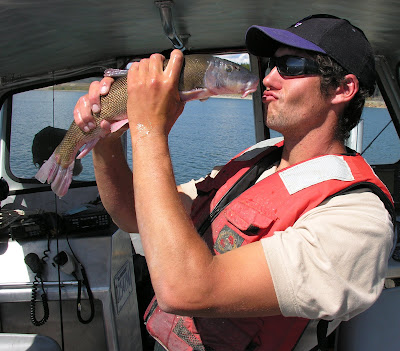
I’m not sure why I love these fish so much, but I suspect it has something to do with their indestructibility. Suckers are invincible, I’m convinced, the Rambos of the fish world. We’ve left suckers high and dry on our boat’s deck for up to an hour, then released them and watched them swim off, totally unfazed. How could you not love such a resilient fish? Any creature with a will to live so intense and a respiratory system so well evolved deserves some affection. The Fisheries Program has a tradition that every newbie kiss the first sucker they encounter; let’s just say the first sucker I met was far from the last one I smooched.

Suckers and otters were among the highlights of the cutthroat assessment, but they weren’t the only perks. We spent the week setting nets at several sites known as cutthroat strongholds, monitoring the species’ health; this brought us into contact with some gorgeous cutts – and, given the population’s failing numbers, it’s always exciting to haul up healthy and huge cutthroat.

Crew chief Brian Ertel holds up a cutthroat too heavy to register on our scale, earning the coveted "really damn heavy" on the data sheet.

Because many of the cutthroat population centers are located in the lake’s extreme southern reaches, to which the insidious lake trout haven’t yet migrated, we sometimes found ourselves setting nets several hours from our home marina. On those nights, we stayed in NPS cabins: fully furnished, albeit very cozy, houses dedicated to rangers and researchers. The first such night, on tiny Peale Island, was predictably fantastic: although a stiff wind prevented us from leaving the island via our canoe all day, the weather cleared up enough for me to take the craft out at midnight, under a canopy of stars so dense that the white swatches of Milky Way overhead nearly dispelled the blackness of the sky. The only sounds that night were bestial: the whistling howl, or “bugle,” of male elks in heat, and the eerie wail of loons echoing across the still water, the cries’ iterations reverberating from shore to shore until our island was veiled by a keening shroud of animal calls.

Sunset down the Southeast Arm of Yellowstone Lake.


***

That night on Peale Island was spectacular, but not unusual: many times Yellowstone has rendered me euphoric through its wildlife, its scenery, the solitude it provides. These last few months have been some of my life's happiest (Australia/New Zealand excepted), and that happiness, interestingly and somewhat discomfortingly, is predicated upon natural influences, and not human ones. I've gotten a bigger kick out of grizzlies and geysers than, well, people. That isn't to say I've been feeling misanthropic, but this realization demands the question: how will I do in Bangkok? Could any two places, Wyoming and Thailand, occupy more extreme ends of a spectrum? Without otters, cutthroat, and sunsets to thrill me, I'll have to squeeze my joy from societal and cultural sources; will I find such joy in the polluted, claustrophobic din of 12 million people? I can honestly say that I can't say. Stick around to find out, I guess.

End.

Sunday, August 30, 2009

The Elements of Style (when it comes to grizz stories)

One of the requisites to living in Yellowstone is a solid repertoire of near-death experiences involving aggressive, predatory, or deranged wildlife. Every park worker has had multiple such scrapes, and judging from the (alleged) frequency and danger of these encounters it’s a miracle that anybody’s still alive. Although no animal is innocuous – I’ve heard harrowing accounts of narrow escapes from mountain lions, elk, bison, mule deer, wolverines, porcupines, and even a feisty chipmunk – most of these stories revolve around the grizzly.


A bad-ass Yellowstone grizz... If only this picture were mine. (It's actually courtesy of Fox News; I feel a little nauseous patronizing their website.)

There’s an art to telling a good grizzly tale, and that art lies in making the encounter sound as perilous as possible without completely shredding the truth. (Some exaggeration, of course, is expected.) Yellowstone workers have mastered the form – I’ve heard many conversations veer into a rehashing of bear encounters, the participants trumping each other by relating increasingly farfetched and terrifying interactions, until by the end one contestant is armed only with a spork and battling a rabid grizz on a rickety rope bridge above a river of lava. (I’m pretty sure that one’s actually true.)

Every grizz story must contain a few key pieces of information to ensure verisimilitude; attempting to recount a grizz encounter without addressing all these details will expose you to suspicion of fraud. Your handy guide to grizz story-telling:

Size of Bear
  • Less than 300 pounds: meh.
  • 300-500 pounds: getting respectable.
  • More than 500 pounds: awe-inspiring.
  • More than 2,000 pounds: you encountered bear while drunk/high, adding new element of excitement to story. Give yourself a pat on the back.

Distance from Bear (always stated in yards, for some reason)

  • More than 100 yards: yawn.
  • 25-50 yards: getting interesting.
  • Less than 20 yards: pretty damn dangerous/awesome.
  • Inside tent: creepy (possibility of bestiality).
Circumstances of encounter (in ascending order of danger):

  • Bear sleeping, eating berries, scratching itself.
  • Bear standing over carcass, caught by surprise, mother with cubs.
  • Bear liquored up and throwing rocks from the Berenstein treehouse.

Don't let the smile fool you: Papa Bear is a mean drunk.


How bear was repelled

  • Shouting, waving arms: lame.
  • The art of Rhetoric: not flashy, but points for ingenuity.
  • Pepper spray: standard.
  • Gun: congratulations, asshole, our sympathies are now with the bear.


***

Whenever these bear-measuring contests arose during my first few weeks in the park, I remained conspicuously silent. My closest animal-related, near-death experience occurred last summer when a squirrel ran in front of my bike, inflicting scrapes, bruises, etc. (Traumatizing for me, maybe, but probably wouldn’t play well for an audience.) So I couldn’t really contribute much to the conversation without making an ass of myself.

I’m proud to say, though, that I recently had my first grizzly encounter. It’s pretty tame by Yellowstone standards, and not likely to win any Bear-Offs, but I won’t forget it in this lifetime.

***

I’m hiking alone down the Washburn Spur Trail, an eight-mile track leading from the top of Mt. Washburn to the Glacial Boulder parking lot, in late afternoon. It’s a cold day – snow flurries at the top of the mountain, hail on the way down – and already darkness has begun to leach into the gray sky. I haven’t seen another person in four miles.

View from the top of Mt. Washburn... my bear is down there somewhere.

The trail plunges below the tree line into thick forest. I’m walking fast, trying to beat the snow and the dark, and I’m silent; breath is a precious commodity. I approach an aspen thicket, about twenty yards ahead and to the right of the path, and the trees rattle, too forcefully to be the wind. I can’t see the animal shaking the trees from within the thicket, but some portion of my brain that operates below conscious thought, a relict from a time when humans were prey, flashes bear. There is no doubt.

I have time to take a single step backward – I’m fifty, maybe sixty feet away – before the bear plows out of the thicket. It’s a huge, tawny, hunchbacked grizz, probably 400 pounds, and it’s in no particular rush – it ambles across the path, its massive head swinging and haunches rolling with the insouciance that comes with being its ecosystem's top predator. I don’t think the bear sees me. With one hand I fumble for my pepper spray, with the other I reach for a camera. I’m not panicked, not even particularly worried: there are no cubs, no carcass, and I didn’t startle the bear. I have nothing to fear.

The bear has nearly crossed the trail when it suddenly rumbles to a halt, sniffs the air, and - ponderously, terrifyingly, inevitably - pivots in my direction. Now, well, I have something to fear. I shuffle backward, fingers fluttering to disengage the safety on my pepper spray. The myriad, and often conflicting, advice about dealing with bears passes through my mind; and yet all of it, from making myself appear as large as possible to shouting, seems risky and antagonistic, more likely to provoke the bear than drive it away. The only thing I can think to do is back away slowly and silently - even though the bear obviously sees me, and could close the twenty meters between us in literally two seconds.

The grizz hesitates and then, to get a better look at me (its rival, its quarry, a curio?) stands up on its hind legs. And, holy fucking shit, this is a big bear, eight feet tall if it's an inch. Rationally I understand that it's only reared up to satisfy its curiosity, but with a grizzly, "curiosity mode" looks an awful lot like "attack mode," and for only the, say, fourth or fifth time in my 22 years I genuinely fear for my life. In retrospect this sounds melodramatic: Yellowstone tourists suffer only one grizzly-related injury per year, and without any of the classic risk factors present, I'm not in much actual danger. In retrospect.

Another picture I didn't take. But I can definitely sympathize with the photographer.

At the time, of course, I'm pretty damn frightened. What makes the situation so alarming isn't the relatively slim danger, but my helplessness should the grizz choose to attack. Bears can run over thirty miles an hour, making flight pointless, and my little cartridge of pepper spray seems insufficient to slow the creature down. I realize that if the grizz elects to attack me, I will be, in essence, completely and totally fucked. Such utter powerlessness is rare in a technologically connected, climate-controlled, highly mobile society; perhaps the foreignness of incapability is what makes the feeling so unnerving.

After a period that feels like half an hour but is probably closer to six seconds, the grizz drops to all fours and thunders into the underbrush from whence it came. My camera, alas, is still in my pocket, but my pepper spray is unholstered and armed - a fact that makes for poor Facebook albums but bodes well for my survival instincts. I wait five minutes, allowing my anxiety to drain and be supplanted by awe at my good fortune: few humans will ever interact with such a spectacular animal at such close quarters.

I proceed cautiously down the trail, fracturing the chill air with an improvised incantation intended to ward off any lurking grizzlies:

Hey Bear!

I know you're out there

Somewhere

But I dare

Walk toward your lair

An affair

That may impair

My future ability to receive health care

And without coverage I'd despair
So please don't maul me.

Etc. (For lines 11-168, see Appendix H.)

An ominous rustle down the trail turns out to be two hikers, both in hysterics over my panicky poem. "Seen a grizz, have we?" asks one of the hikers, with a smirk. I tell my story, and they listen respectfully, oohing appreciatively at the appropriate moments.

A 400-pound grizz encountered alone on the trail, at just sixty feet, on its hind legs. I may not win any story-telling contests with this one, but at least I'm qualified to sit at the campfire.


End.

Saturday, August 29, 2009

Close Encounters, Part 1: Of Moose and Tourons

Most tourists visit Yellowstone in hopes of encountering wildlife (and not, say, slaying lake trout… though to those people I say, don’t knock it ‘til you try it). Anyway, to prove that I’m capable of interacting with nature in ways not predicated upon ritual slaughter, an anecdote from the YNP trails:

***

One of the most important, inflexible rules of hiking in grizzly country is this: do not, under any circumstances, approach an animal carcass. Grizzlies are inveterate scavengers and, even if that carcass hasn’t yet been claimed by a bear, one will soon sniff it out. And when a hungry grizz comes in search of a meal, you’re well-advised to make yourself scarce.

I’m generally a law-abiding guy, but when I stumble across a freshly expired moose not 100 yards from the trail… well, you know the adage about rules, and how they’re meant to be broken? The author of that maxim has clearly spent some time investigating the corpses of enormous mammals.


If getting excited about a giant dead moose along the trail is wrong, I don't want to be right.

I’m by myself, partway through an 11-mile trek to a mountain called Observation Peak, when I see the antlers rising from the grass to my right like topmasts. I break from the trail and wade through the brush until I find the unfortunate beast, sprawled before me in a clearing, liquid eyes half-open as though I’d caught it in a moment of repose. The carcass is fresh and flawless; it can’t have died more than a few hours ago. It doesn’t even stink yet.

I check my periphery for prowling grizzlies, and, deciding that I’m not interfering with any bear’s breakfast, gingerly prod my moose. Aside from the whole death thing, the animal looks perfectly healthy. I stroke the velvet that covers the gnarled antlers, and it’s as soft as any fabric I’ve ever touched – a texture that could never be predicted from the bleached, inanimate antlers that adorn the walls of any hunting lodge.

There’s something almost reassuring about the manner of this moose’s death, I think: there’s no bullet wound, no imprint of a car fender. It died, as far as I can tell, of natural (read: non-human) causes. And that’s why national parks exist: they’re sanctuaries for normal ecological processes, preserves not only for animal life but for death as well, places where the bodies of moose are stripped of their nutrients by bears and wolves and coyotes and returned to the soil to grow the vegetation that eventually feeds other moose, and so on and so forth. The ecosystem that I’ve been dealing with, Yellowstone Lake, is so altered and degraded by human activity that we interlopers have to actively (micro)manage it; the National Parks Service controls what fish live and die, with a guiding hand so firm upon the tiller that the ecosystem is no longer ‘natural’ in any legitimate sense. And this is true the world over: humanity’s influence has encroached upon every ostensibly wild space, whether via resource extraction or recreation or climate change. The notion that wildlife may be killed by “natural causes,” as distinguished from anthropogenic causes, is rapidly becoming obsolete. Our species is frighteningly ubiquitous.

Maybe that’s why this moose, apparently unbranded by human iron, so interests me.

Aside from being taken on that fateful Observation Peak hike, this picture is apropos of nothing; I just wanted to break up the text. I'm sufficiently secure in my masculinity to admit that half the pictures I took that day were of
cool pink wildflowers.

***

Two passing hikers, a married couple, see me examining the deceased, no doubt with such curiosity and thoroughness that I could be auditioning for CSI: Wyoming. (Wouldn't be much of a show, incidentally, since almost every crime here seems to incorporate the same two ingredients: a shotgun and a case of PBR.) The man approaches the carcass to take pictures, while the woman stays on the trail and frets very vocally about grizzlies.

I mention to her husband that her concerns are probably valid and he says, “Well, I’m a touron.”

“What’s a touron?” I ask.

“Cross between a tourist and a moron,” he says. I say that I guess I’m a touron too, and ask him to take a picture of me holding the moose by the antlers, like I’ve just bagged it. An embryonic thought about respect for the dead pops into my mind and then dies in utero: ethical concerns must sometimes be trumped by great photo ops. Flies gather on moist ungulate eyes as the shutter clicks.


This moose sacrificed its life for a worthy cause: I now have the perfect pick-up line for the next time I'm chatting up Sarah Palin down at the local hockey rink.

***

I’m returning from the top of Observation Peak that afternoon when I meet three backcountry rangers. They’re closing the trail, they tell me: grizzly activity near the carcass has made the route unsafe. A 500-pound bear named Scarface has been spotted near the moose, and though Scarface is typically benign, I can certainly understand why the authorities would want to minimize contact between a feeding grizz and a park full of tourons. The rangers and I piece together a timeline, and decide that Scarface must have entered the vicinity less than twenty minutes after I vacated it. I part ways with the rangers (after a long conversation about fly-fishing, of course) and head for the trailhead, feeling in equal parts fortunate and disappointed that Scarface and I hadn’t crossed paths.

I have no idea that my first brush with a grizzly will occur much sooner, and at much closer range, than I could possibly expect. (Cliffhanger!!!)

End

Tuesday, August 25, 2009

Consider the Lake Trout. Or, on Second Thought, Screw 'Em.

David Foster Wallace may have felt reservations about whether it was all right for humans to boil crustaceans alive for our gustatory pleasure… but would he have felt similarly reluctant to bash the head of an invasive fish against a boat railing? Would the famously compassionate writer have been able to stomach the extermination of an entire population of trout?

Would he have objected to the ruthlessness of the project, or would it have been the mode of extirpation that bothered him: the gillnets draped beneath the surface of Yellowstone Lake like invisible, lethal cobwebs, ensnaring and suffocating all piscine comers? Could any method of slaughter mollify the sensitive, thoughtful DFW?

Perhaps not. Good thing I'm a jerk.

***

Maybe we all possess some latent, Wallacean compassion within our souls… but lake trout - the invasive species that is threatening Yellowstone National Park's ecosystem, and that I have been contracted to eliminate - definitely don’t activate that warmth within me.


An evil, invasive lake trout disgorges a juvenile native cutthroat trout. I see this image in my nightmares.

Lake trout look, first, like the enemy: torpedo-shaped body and elongated, toothy jaws; sinister black mottling that must make them impossible for their hapless prey to detect; and even – though I must be imagining this – a certain willful malignancy in their soulless eyes. (Anthropomorphizing nature is typically a marker of authorial weakness, one which Ed Abbey in particular hates, but I swear that in this case it's applicable and valid. Really.)

The cutthroat trout, the good guys, on the other hand, look as virtuous as the lakers do evil. The cutts are beautiful fish, ranging in coloration from pale gold to pink to deep red, constellations of black spots along their flanks, and their faces possess the same hollow, dopey, good-natured, preyed-upon vacuousness as sheep. The point is, it’s easy to choose sides.

A cutthroat trout... ain't he adorable? Dontcha just want to kiss him? Me too.

Malevolent countenances aside, the lake trout are horrifically destructive. Introduced by fishermen (short-sighted bastards) in the mid-‘90’s, their population has metastasized explosively, so much so that the National Parks Service has managed to remove 70,000 (!!!) this year without even making a dent in their numbers. Yellowstone Lake contains, in fact, one of the healthiest lake trout population in the country. If you’re ecologically inclined, they appear to be both a k- and r-selected species, meaning that they reproduce rapidly and live forever (up to fifty years, compared with eight or nine for the oldest cutthroat.)

Lake trout are voracious and efficient predators; our autopsies of them reveal bellies full of young cutthroat. Juvenile cutts, not incidentally, are very rare in Yellowstone Lake – while our nets pull up hundreds of fledgling lakers measuring 300 mm or less, the only cutthroat we see are the real ‘hogs,’ adult fish over 500 mm. This discrepancy troubled me for a while, until the blindingly obvious solution arrived: there are no young cutthroat, of course, because they get devoured; this creates an unsustainable population skewed toward the large and elderly. The situation’s like an aquatic Children of Men.

If the lake trout only ate the cutthroat, the ecosystem’s prospects would be grave, but not dire. Unfortunately, the lake trout exhibit another deleterious behavior: true to their name, they don’t leave the lake. While the cutthroat trout migrate up Yellowstone Lake’s many branching streams to spawn, the lakers do their baby-making in the deep waters of the lake itself. Problem is, many other species, from grizzlies to eagles, depend on the migrating cutthroat for food: once the fish leave the safety of the lake’s depths and enter shallow stream waters, they become accessible to these predators. If the lake trout supplant the cutthroat, this migratory buffet will vanish, exposing terrestrial species to starvation. To synopsize, and hopefully impart the gravity of the situation: if the lake trout aren’t removed, the entire ecosystem of the most iconic National Park in America is in jeopardy. And right now, the lake trout are winning.

***

Fellow intern Erinn Hasselgren holds up a record-setting 25.75 lb lake trout, the largest ever removed from Yellowstone Lake. Obviously this would never have been possible were it not for Erinn's sweet hat. Picture courtesy of gillnetting legend Adam Lohmeyer.

So, yeah, lake trout suck. And that’s why, whenever our nets drag a live, writhing laker to the surface, I have no trouble slamming the fish against the gunwale until it stops twitching. I’m not out to induce suffering, but I very much want the fish dead.

But truly I’m a scientist, not a slaughterer*. I’m part of a three-man reconnaissance crew currently conducting a Lake Trout Distribution Assessment, trying to figure out where the lake trout have established their strongholds**. Once we’ve identified a pocket of lakers, we send in the true grim reapers, the larger and better equipped factory ships capable of doing the really hardcore killing: a typical day for the Freedom, our fleet’s flagship, is eight hundred lake trout.


Fisheries technician Jason "Babyhands" Bunn strikes a familiar pose. Note the artfully placed "crotch trout." Picture courtesy of Alex Crouse.


***

I realize that slaughtering fish, and then handling their slimy, bloody, reeking corpses, is not everybody’s cup of tea; in fact, you may right now be wondering who in their right mind could enjoy a job that leaves one stinking like the dumpster behind your local Red Lobster***. But despite its gruesome, odiferous nature, I love this job. Or maybe I love this job not despite its gruesome, odiferous nature, but because of it: because it’s so far removed from Amherst’s sterility; because it activates and caters to some gloriously foul childhood instincts; because, after performing this job, I feel confident that nothing could ever disgust me again. I can now perform any nasty task without the slightest aversion; such imperviousness to all things gross is not only useful, but also, blessedly, pushes me further from a world of white collars and unstained shirts that I may never be ready to enter.

Familiar circumstances for me: holding a fish, and grinning like Ralphie Parker on Christmas morning.

***

Or maybe it’s being on the lake that I love: the enormous gray lake ringed by jagged mountains whose foothills plunge to touch the water’s edge, closing us off from the obnoxious, crowded world beyond. Setting nets and hauling in fish is fun, for sure, but my favorite part of each day is the time we spend with the throttle open: the skiff bouncing across the swell like a skipped stone, the roar of the engine reduced to gentle white noise by my earmuffs, an expectant parade of seagulls trailing us like acolytes. We’re on the edge of a storm front; the blunt heads of thunderclouds race us toward shore. Behind us a skein of rain turns the mountains gray, then blots them out; before us the sky is still blue and brilliant – it’s as though the storm is tethered to our stern, as though we’re dragging it behind us like a cape. Behind us, Yellowstone’s vast, forbidding backcountry turns black in the gathering dusk.


The unimaginatively named (but still beloved by me) Work Skiff 1 at rest on Peale Island, about a billion miles off the beaten path.

I look forward again – toward the clear sky, the gentle chop, the slab of fresh lake trout I can already smell sizzling in a pan (the wastivore's paradise!), and the warm sleeping bag. The wilderness can wait.

End.


*In addition to killing the fish, we also take reams of data – including our victims’ lengths, weights, sexes, degree of sexual maturity, and, most interestingly, age. The latter is calculated by removing from each fish its otolith, a pinhead-sized piece of bone, located approximately between the eyes, that can be used like the rings of a tree core.

**As the Distribution Assessment team, we often set our nets without knowing whether we’re above lake trout habitat; consequently we haul in a large number of cutthroat as bycatch, much to our chagrin. The lake trout favor deeper waters (>30 meters), while the cutts prefer shallow (<20 m); thus a net set in shallow water is almost assured to catch predominantly cutthroat. Still, the Powers That Be, in the name of complete scientific rigor, have instructed us to set nets in the shallows as well – despite our crew's protestations. Therefore we continue to catch cutthroats, the species we’re ostensibly protecting, in tragic numbers. Well, to make an omelet…

***If, when next I see/hug you, I still smell like a wad of sludge dredged up from the floor of the Long Island Sound, rest assured that, all odors to the contrary, I have showered in the last four months.